Investment Market Cycles
Note: Market leadership rotates in cycles. What dominates one decade often underperforms the next as capital flows to opposite themes.
Historical Investment Cycles
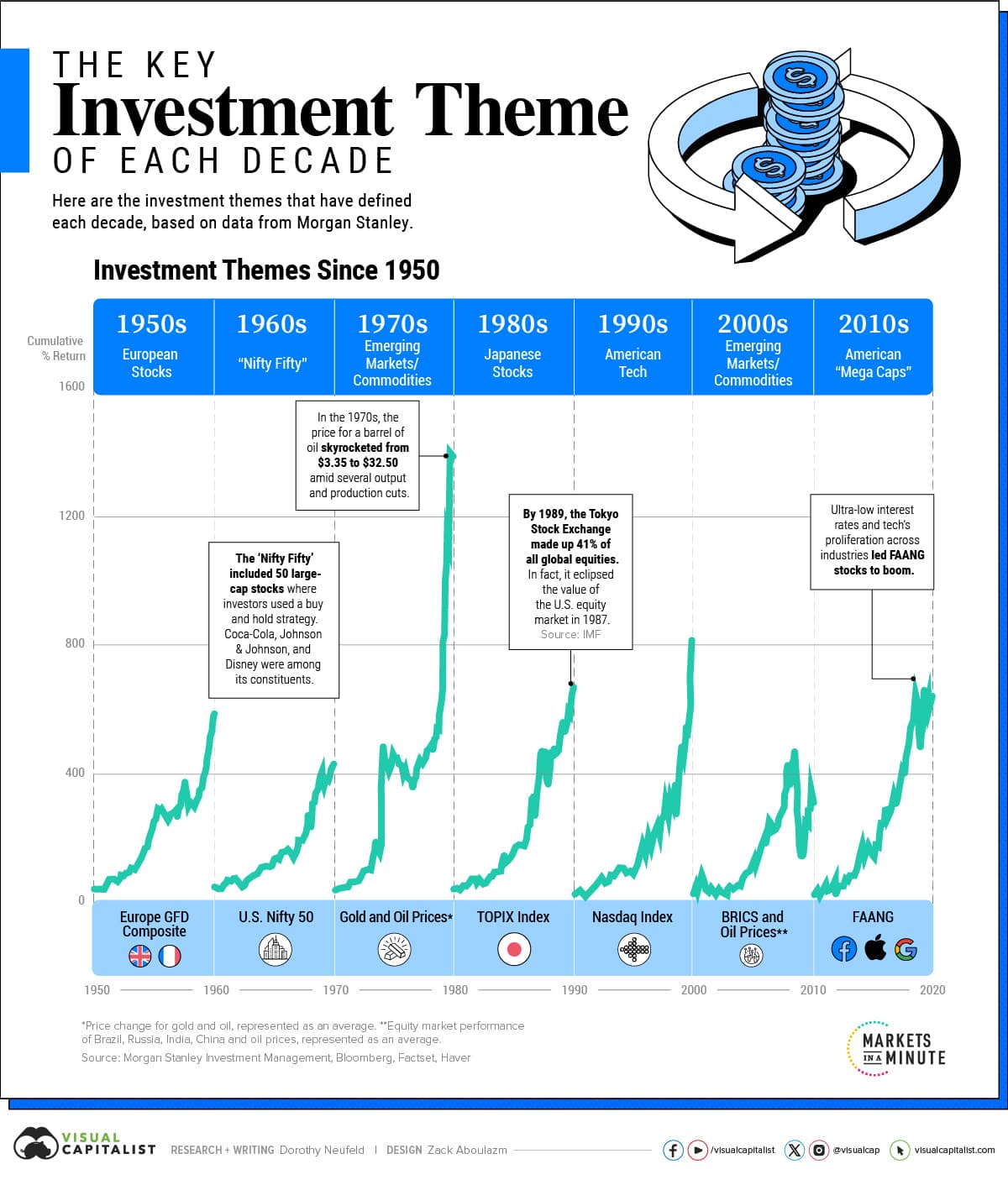
Investment Themes by Decade
| Decade | Theme | Index |
|---|---|---|
| 1950s | European Stocks | Europe GFD Composite |
| 1960s | "Nifty Fifty" | U.S. Nifty 50 |
| 1970s | Emerging Markets / Commodities | Gold and Oil Prices* |
| 1980s | Japanese Stocks | TOPIX Index |
| 1990s | American Tech | Nasdaq Index |
| 2000s | Emerging Markets / Commodities | BRICs and Oil Prices** |
| 2010s | American "Mega Caps" | FAANG |
| 2020s | Decentralization & AI (FAANG → CRAP) | Crypto + AI Infrastructure (BTC, ETH, SOX) |
The 4 Oppositional Levers
These are not "criteria" in an academic sense — they're axes that flip when regimes change. These four levers describe every major capital rotation of the last 80 years.
Geography
• US ↔ non-US
• Developed ↔ emerging
• Domestic ↔ global
Asset Type
• Financial claims ↔ real/hard assets
• Long-duration ↔ short-duration
• Equity ↔ commodity/rates/credit
Sector / Economic Engine
• Manufacturing ↔ services ↔ platforms
• Physical ↔ digital
• Resource extraction ↔ innovation/IP
Valuation / Duration
• Cheap/neglected ↔ premium/"one-decision"
• Near-term cash flow ↔ distant narrative
Capital Rotation by Decade
1950s
European Stocks4 Oppositional Levers:
Global capital preservation
European reconstruction leadership
Cash/safe assets
Equities tied to physical rebuilding
Destruction/defense
Infrastructure, housing, industrial recovery
Capital protection
Cheap assets with near-term rebuild payoff
1960s
"Nifty Fifty"4 Oppositional Levers:
Europe
United States
Cyclical rebuild equities
Blue-chip growth equities
Industrial reconstruction
Consumer brands and corporate conglomerates
Cheap, mean-reversion assets
Premium long-duration 'one-decision' stocks
1970s
Emerging Markets / Commodities4 Oppositional Levers:
US-centric leadership
Resource-rich and emerging regions
Financial assets
Hard assets and inflation hedges
Consumer/corporate growth
Energy, materials, and extraction
Premium long-duration growth
Spot-priced, short-duration assets
1980s
Japanese Stocks4 Oppositional Levers:
Commodity exporters
Japan as economic center
Real assets
Financial assets and equities
Extraction
Manufacturing, exports, and industrial efficiency
Inflation-driven pricing
Multiple expansion and asset inflation
1990s
American Tech4 Oppositional Levers:
Japan
United States
Capital-intensive industrials
Capital-light tech equities
Manufacturing
Software, networks, and IP
Asset-backed valuation
Extreme long-duration growth expectations
2000s
Emerging Markets / Commodities4 Oppositional Levers:
US tech leadership
Emerging markets and exporters
Virtual/digital claims
Physical resources and infrastructure
Internet/software
Energy, metals, construction
Narrative-driven long duration
Cash-flow and spot-driven assets
2010s
American "Mega Caps"4 Oppositional Levers:
Global EM breadth
US-centric dominance
Resource extraction
Digital platforms and data monopolies
Materials/infrastructure
Software, marketplaces, networks
Cyclical cash-flow assets
Ultra-long-duration growth at scale
2020s
Decentralization & AI (FAANG → CRAP)4 Oppositional Levers:
US-centric platform monopolies
Multipolar networks (crypto global, AI competition across blocs)
Platform equities and paper stocks
Digital-native assets (crypto) + physical compute and data infrastructure
Consumer platforms and ad-driven software
Protocols, trading infrastructure, AI systems, and optimization engines
Premium growth priced on platform permanence
Barbell outcomes: speculative protocol upside + strategic scarcity in compute and infrastructure